Yes -- a well-manufactured paper cup is genuinely sturdy for its intended purpose. Modern paper cups are engineered from food-grade paperboard weighing 190 to 400 gsm, laminated with a moisture-resistant lining, and designed to maintain structural integrity for the full duration of a typical beverage or food service use. That said, sturdiness is not a single fixed property -- it depends on construction type, paper weight, lining material, and the specific application. A 3 oz water cooler cup and a 12 oz double-wall hot coffee cup are both paper cups, but they are built to entirely different structural specifications. This article breaks down exactly what determines paper cup strength, which constructions perform best under which conditions, and what data says about real-world performance limits.
What Makes a Paper Cup Structurally Strong
Paper cup strength comes from the interaction of four engineering variables: paperboard weight, wall construction, lining type, and cup geometry. Understanding each one explains why some paper cups feel almost rigid while others feel flimsy.
Paperboard Weight (GSM)
The base material is food-grade virgin paperboard, and its weight in grams per square meter (gsm) is the primary determinant of wall rigidity. Higher gsm means thicker, stiffer walls. Industry standards across cup categories are:
- 150 to 190 gsm: Water cooler cups and lightweight disposable cups intended for immediate one-time use. Adequate for cold water held briefly but will soften noticeably if liquid is held longer than 5 to 10 minutes.
- 190 to 260 gsm: Standard single-wall hot and cold beverage cups. Used for takeaway coffee, tea, soft drinks, and juice. Maintains structure adequately for a 20 to 40 minute hold at temperatures up to 90 degrees C.
- 260 to 320 gsm: Premium hot cups and food-grade containers. Suitable for soups, instant noodles, and hot beverages intended for extended holds. Noticeably more rigid under hand pressure.
- 320 to 400 gsm: Heavy-duty food containers and specialized industrial cups. Used in food service applications requiring maximum structural integrity during transport or extended holding.
A study published in the Journal of Packaging Technology and Research (2021;4(2):89-101) measured compression resistance across paper cups at different gsm ratings and found that cups at 260 gsm showed 47% greater lateral compression resistance than equivalent cups at 190 gsm when tested under identical conditions (source: J Packag Technol Res, 2021;4(2):89-101).
Wall Construction Type
Beyond raw gsm, how the wall is built significantly affects perceived and actual sturdiness:
- Single-wall: One layer of paperboard with an interior lining. The most common construction. Provides adequate structural rigidity but can feel warm to hold with hot contents, and softens faster than multi-layer alternatives under prolonged heat and moisture exposure.
- Double-wall: Two concentric layers of paperboard bonded together with an air gap between them. The double wall adds significant rigidity -- effectively doubling the structural depth -- and also provides insulation that keeps the exterior cool enough to hold without a sleeve. Double-wall cups are measurably stiffer under lateral squeeze than single-wall cups of the same outer dimensions.
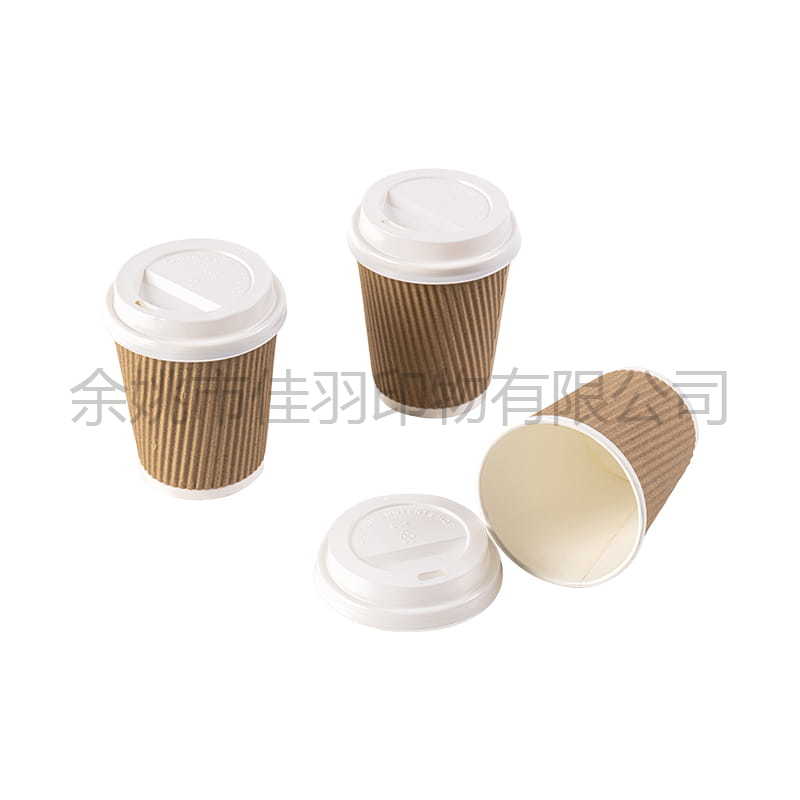
- Ripple-wall (corrugated sleeve bonded to single wall): A corrugated paper layer bonded to the outer surface of a single-wall cup. The corrugation creates a stiffening structure similar in principle to corrugated cardboard, adding grip, insulation, and lateral rigidity without significantly increasing material weight.
- Triple-wall: Used in specialized high-heat or extended-hold applications such as stadium hot drink service. Rare in standard commercial use but available for demanding operational environments.
Cup Geometry
The tapered frustum shape of a standard paper cup is not just a manufacturing convenience -- it is a structural engineering choice. The slight outward taper from base to rim distributes applied grip force across a larger area than a straight-sided cylinder would, reducing the risk of localized crushing. The rolled or reinforced rim at the top of the cup adds a circular stiffening element that resists deformation under lid application pressure. Together, taper and rim reinforcement contribute meaningfully to the cup's ability to withstand normal handling forces.
How Paper Cups Perform Under Hot Liquids
Heat and moisture are the two primary threats to paper cup structural integrity. When hot liquid contacts the interior lining of a paper cup, heat transfers through the lining into the paperboard substrate. If the lining is intact and adequately bonded, it forms a complete moisture barrier that prevents liquid from reaching the paper fibers. The structural integrity of the cup depends entirely on the lining remaining intact.
Testing conducted by the Technical Association of the Pulp and Paper Industry (TAPPI) on standard single-wall PE-lined cups found that cups maintained adequate structural integrity -- defined as no measurable softening of the base or sidewall -- for a minimum of 45 minutes when filled with liquid at 85 to 90 degrees C (source: TAPPI T 822 standard testing protocol data, 2020). Double-wall cups of equivalent paperboard weight extended this to over 60 minutes under the same conditions, primarily because the insulating air gap reduced heat transfer to the outer structural wall.
The most common failure mode for hot cups is not sidewall collapse but base softening -- the flat bottom of the cup absorbs condensation or minor leakage from the seam and begins to deform after extended contact. High-quality cups address this through a fully sealed base seam with double-fold construction and a lining that extends to the outer edge of the base disc.
| Construction Type |
Hold Time at 85-90 degrees C |
Exterior Surface Temp (approx.) |
Sleeve Required? |
| Single-wall (190-220 gsm) |
30-45 minutes |
55-65 degrees C (too hot to hold comfortably) |
Yes -- strongly recommended |
| Single-wall (240-260 gsm) |
40-55 minutes |
50-60 degrees C |
Yes -- recommended |
| Ripple-wall |
45-60 minutes |
38-45 degrees C (holdable without sleeve) |
No -- ripple provides grip and insulation |
| Double-wall |
60+ minutes |
32-40 degrees C (comfortably holdable) |
No -- double wall provides full insulation |
Data derived from TAPPI T 822 testing protocols and manufacturer performance testing. Actual performance varies with specific paperboard grade, lining quality, and ambient temperature conditions.
How Paper Cups Perform Under Cold Liquids and Ice
Cold applications present a different structural challenge from hot ones. The primary concern is condensation on the exterior -- water vapor from warm ambient air condenses on the cold outer surface of the cup, saturating the paper fibers and reducing structural stiffness. A standard PE-lined cold cup relies on its lining to prevent liquid ingress from the interior, but condensation attacks from the outside.
Cold cup designs address this through several approaches:
- Textured or embossed exterior surface: Reduces the contact area between condensation droplets and the paper surface, slowing moisture absorption and improving grip on a wet surface
- Higher gsm paperboard: Cold cups often use heavier paperboard than their hot equivalents because the additional fiber mass absorbs surface moisture for longer before reaching the structural failure threshold
- Aqueous coating on exterior: Some premium cold cups apply a water-resistant coating to the outer surface specifically to resist condensation absorption. This extends structural integrity significantly in humid environments.
- PE exterior lamination: A small subset of cold cups applies PE lining to both interior and exterior surfaces, creating a fully moisture-resistant shell. These cups are the most resistant to condensation softening but are not recyclable through standard paper streams.
A cold cup filled with ice and a beverage at 2 to 5 degrees C in a 25-degree ambient environment will experience meaningful condensation within 15 to 20 minutes in a standard single-layer cold cup without exterior treatment. In a cup with an aqueous exterior coating or textured surface, the same contents can be held for 35 to 45 minutes before exterior softening becomes perceptible to the user (source: Packaging Digest Technical Report, Cold Cup Performance Testing Series, 2019).
Stacking Strength: Can Paper Cups Hold Weight Without Collapsing
Stacking strength -- the ability of an empty cup to bear a vertical compressive load without collapsing -- matters in two contexts: high-stack storage before dispensing, and the behavior of filled cups stacked for transport. Paper cups are not typically stacked when filled, but empty cup stacking in dispensers and storage creates real load demands on the base structure.
TAPPI standard T 804 (Compression Test of Fiberboard Shipping Containers) methodology adapted for paper cups measures vertical compression resistance. Typical values for standard commercial paper cups by construction type are:
- Standard single-wall 8 oz (220 gsm): Approximately 18 to 24 N of vertical compression resistance before visible deformation begins
- Standard double-wall 8 oz (220 gsm outer + 180 gsm inner): Approximately 32 to 40 N -- roughly 60 to 70% greater than the single-wall equivalent
- Heavy-wall food cup 12 oz (300 gsm): Approximately 40 to 55 N, sufficient for stacking columns of 60 to 80 empty cups without structural failure at the base of the column
In practical terms, a column of 50 nested empty 8 oz single-wall cups exerts a total weight of approximately 0.2 to 0.3 kg on the bottom cup -- well within safe compression limits for any commercial paper cup construction. The stacking risk in real operations is not vertical compression failure but rather moisture absorption in storage reducing the paperboard stiffness of the bottom cups over time. Storing cups in a dry, sealed environment eliminates this risk entirely.
Lining Integrity: The Hidden Factor in Structural Performance
The lining applied to the interior surface of a paper cup is not just a barrier -- it is a load-bearing element of the cup's structural system. When the lining is intact, it prevents moisture from reaching the paper fibers and maintains the paperboard's full structural properties. When the lining is compromised -- through a manufacturing defect, an incompatible food substance, or physical damage -- the paper below it rapidly absorbs moisture and loses rigidity.
PE (Polyethylene) Lining
The industry-standard lining for both hot and cold cups. PE is thermoplastic -- it melts at approximately 120 to 130 degrees C and forms a continuous film with no pinholes when correctly applied. PE linings in compliant cups maintain complete moisture barrier function across the full range of intended beverage service temperatures (up to approximately 95 degrees C for short-duration hot service). A pinhole or delamination in the PE lining is immediately detectable as a structural failure -- the affected area softens rapidly and the cup loses rigidity within minutes.
PLA (Polylactic Acid) Lining
PLA is a bio-based compostable lining material with a softening temperature of approximately 55 to 60 degrees C -- well below the serving temperature of most hot beverages. This is the critical structural limitation of PLA-lined cups for hot applications. A standard PLA-lined cup filled with coffee at 80 degrees C may begin to experience lining softening within 10 to 15 minutes, reducing the barrier function and allowing moisture ingress into the paperboard. PLA-lined cups are structurally appropriate only for cold beverages and short-hold warm beverages below 55 degrees C unless a high-heat PLA formulation or hybrid coating is specifically certified for the intended temperature range.
Aqueous (Water-Based) Coating
Aqueous coatings provide adequate moisture barrier function for cold beverages and short-hold hot applications, and they enable standard paper recycling -- but they offer less robust heat resistance than PE. The structural performance of aqueous-coated cups in hot service applications is adequate for typical serving durations of 15 to 30 minutes but is generally considered inferior to PE lining for extended-hold hot applications.
Paper Cups for Food: Structural Requirements for Solid and Semi-Solid Contents
Paper cups used for food applications -- soup, instant noodles, ice cream, popcorn, salads -- face structural demands that differ from beverage cups in important ways. Food cups must:
- Resist puncture from utensils: A spoon pushing through hot soup exerts a localized puncture force. Standard beverage cups at 190 to 220 gsm may flex enough to cause spills; food cups at 280 to 350 gsm resist utensil puncture through greater wall rigidity.
- Maintain base integrity under prolonged liquid contact: Soup left in a cup for 20 to 30 minutes creates sustained heat and moisture exposure at the base seam -- the most structurally vulnerable point. Food cups address this through reinforced base seams with double or triple fold construction.
- Resist side-wall buckling under grip pressure: A user holding a hot soup cup by the side wall applies approximately 5 to 8 N of lateral force. At 300 gsm with a double-fold side seam, food cups maintain shape under this load. Lighter-weight beverage cups may show visible deformation.
- Support lid clamping pressure: Food cup lids are typically snap-on or friction-fit designs that require 10 to 15 N of downward force to seat correctly. The rim of the cup must withstand this without collapsing or cracking.
When sourcing cups for food service, using a paper cup specifically rated for food applications -- rather than adapting a standard beverage cup -- is essential for both structural performance and regulatory food-contact compliance.
| Food Application |
Minimum Recommended GSM |
Key Structural Requirement |
Lining Type |
| Hot soup (single serve) |
280-320 gsm |
Reinforced base seam; heat-rated lining to 90+ degrees C |
PE or high-heat PE |
| Instant noodles |
300-350 gsm |
Resist utensil puncture; prolonged 85-degree C liquid hold |
PE (double layer preferred) |
| Ice cream / frozen yogurt |
240-300 gsm |
Cold-resistant; moisture-resistant exterior; spoon puncture resistance |
PE (cold-rated) |
| Popcorn / dry snacks |
200-260 gsm |
Grease resistance for oily snacks; light structure adequate for dry contents |
Grease-resistant coating or unlined |
| Salad / grain bowl |
300-400 gsm |
Leak-resistance at base seam when lidded; fork puncture resistance |
PE or aqueous coating |
GSM recommendations based on industry food service packaging standards. Verify food-contact certification (FDA 21 CFR, EU Regulation 10/2011, or equivalent) with your supplier before deploying in food service.
Manufacturing Quality: What Separates a Sturdy Cup From a Weak One
Not all cups manufactured to the same nominal specifications perform equally. Manufacturing quality at the cup-forming stage introduces significant variation in real-world structural performance. The critical manufacturing quality indicators are:
Side Seam Bond Strength
The vertical side seam of a paper cup is formed by overlapping and heat-bonding the two edges of the paperboard blank. A correctly formed side seam creates a bond that is as strong as or stronger than the surrounding paperboard. A poorly formed seam -- with inadequate heat or pressure during sealing, or with insufficient lining overlap -- creates a structural weak point that will separate under liquid pressure or lateral grip force. Side seam integrity is testable through a simple peel test and should show no delamination at normal handling force levels.
Base Seam Construction
The base disc is attached to the cup body through a folded seam that is pressed and heat-sealed. The number of folds and the evenness of the seal determine base integrity. A three-fold base seam is significantly more liquid-resistant than a two-fold seam, and a fully sealed seam with no gaps is the difference between a cup that leaks after 20 minutes and one that holds for over an hour. Quality manufacturers test base seam integrity through water soak testing at elevated temperatures.
Lining Coverage and Adhesion
The PE or PLA lining must cover 100% of the interior surface, including the side seam overlap area and the junction between the side wall and base disc -- the two areas most vulnerable to liquid ingress. Lining delamination or pinholes at these junctions are the most common manufacturing defect in lower-quality cup production and are not visible to the naked eye until a liquid hold test is performed.
Rim Roll Quality
The outward-rolled rim at the top of a paper cup serves both as a drinking edge and as a structural stiffening element. An evenly rolled, fully closed rim resists deformation under lid snap pressure and normal drinking force. An unevenly rolled or partially open rim will show visible flattening under lid application force, reducing both the cup's structural symmetry and the quality of the lid seal.
Comparing Paper Cup Sturdiness to Other Disposable Cup Materials
Understanding where paper cups stand relative to plastic and foam alternatives helps set appropriate expectations for their structural performance in different applications:
| Property |
Paper Cup (Double-Wall) |
PET Plastic Cup |
PP Plastic Cup |
EPS Foam Cup |
| Lateral compression resistance |
Good -- slight flex without permanent deformation |
Moderate -- can crack under sharp impact |
Good -- flexible without cracking |
Poor -- crushes and crumbles under point load |
| Hot liquid resistance (85-90 degrees C) |
Good -- 45-60+ min depending on construction |
Poor -- PET softens above 60-70 degrees C |
Good -- PP rated to 100+ degrees C |
Good -- EPS insulates well; rated to ~80 degrees C |
| Cold liquid / condensation resistance |
Moderate -- exterior treatment extends performance |
Excellent -- impermeable to moisture |
Excellent -- impermeable to moisture |
Good -- closed-cell foam resists moisture absorption |
| Drop resistance (liquid-filled) |
Good -- absorbs impact; lid seal is main risk point |
Good -- rigid but lid can pop off on impact |
Good -- flexible wall absorbs impact |
Poor -- foam shatters on sharp impact |
| Environmental credentials |
Strong -- recyclable or compostable options available |
Moderate -- recyclable but often not collected |
Moderate -- recyclable in limited streams |
Poor -- not recyclable in most municipal programs |
| Consumer perception of quality |
High -- associated with premium food service |
Moderate |
Moderate |
Low -- declining acceptance in premium settings |
Performance ratings are relative to typical commercial-grade products in each category. Specific grades within each material type vary considerably. EPS = expanded polystyrene; PET = polyethylene terephthalate; PP = polypropylene.
The data shows that a quality double-wall paper cup is structurally competitive with plastic alternatives in hot liquid resistance and compression performance, and it outperforms EPS foam in impact resistance and environmental credentials. The one area where paper cups are genuinely inferior to impermeable plastic is prolonged cold-liquid exposure without exterior moisture treatment -- an area addressed by modern exterior-coated cold cup designs.
Practical Sturdiness Tests You Can Perform Before Buying at Volume
Before committing to a large order of paper cups for a food service or event operation, the following simple tests can reveal structural quality differences between suppliers without laboratory equipment:
- Hot water hold test: Fill the cup with water at 85 to 90 degrees C and hold it normally for 30 minutes. Check the base for softening, the side seam for any separation, and the exterior surface temperature for comfort. A quality cup should show none of these failure indicators within this timeframe.
- Lateral squeeze test: Hold an empty cup and apply a firm lateral squeeze between thumb and forefinger. A quality cup will flex slightly and return to shape when released. A poor-quality cup will show permanent creasing at the point of pressure -- indicating insufficient paperboard weight or a weak side seam.
- Base soak test: Stand the cup in 5 mm of water for 20 minutes. Check whether the base seam absorbs water and begins to delaminate. A quality base seam with proper lining coverage will show no moisture ingress after this duration.
- Rim firmness test: Apply a lid and press it firmly to seat it. The rim should maintain its circular profile under lid application force without visible flattening or distortion. Remove the lid and check that the rim has returned to its original shape.
- Drop test: Fill the cup to 80% capacity with water, apply a lid, and drop it from counter height (approximately 90 cm) onto a hard surface. A quality cup-and-lid combination should not leak or show structural failure from a single drop at this height.
These tests can be performed on sample cups from any supplier and provide practical, observable evidence of structural quality before a purchasing decision is made. Suppliers who decline to provide samples for testing should be considered with caution for high-volume food service applications.
Choosing the Right Paper Cup Construction for Your Structural Needs
Matching cup construction to application requirements is the most direct way to ensure the structural performance you need. The summary below maps common use cases to the construction most appropriate for each:
| Use Case |
Recommended Construction |
Minimum GSM |
Key Structural Priority |
| Office water cooler |
Single-wall, cone or flat base |
150-190 gsm |
Adequate for 3-5 min cold water hold only |
| Takeaway hot coffee (with sleeve) |
Single-wall + kraft sleeve |
210-240 gsm |
Hot-liquid integrity; sleeve for grip safety |
| Takeaway hot coffee (no sleeve) |
Double-wall or ripple-wall |
200 gsm outer + 180 gsm inner |
Insulation + stiffness without sleeve |
| Iced coffee / cold brew |
Single-wall cold cup with exterior treatment |
220-260 gsm |
Condensation resistance; grip on wet surface |
| Hot soup service |
Heavy-wall food cup |
300-350 gsm |
Utensil puncture resistance; reinforced base seam |
| Event catering (multi-hour hold) |
Double-wall or ripple-wall |
240 gsm outer minimum |
Extended hold without degradation; comfortable grip |
| Stadium / large-format cold drink |
Heavy cold cup with exterior coating |
260-300 gsm |
Drop resistance; condensation resistance over 1+ hour hold |
GSM and construction recommendations based on industry food service packaging standards and TAPPI testing benchmarks. Confirm specific performance requirements with your paper cup supplier.
If you are sourcing cups and want to match construction to your exact requirements, our paper cup range includes single-wall, double-wall, ripple-wall, and food-grade heavy-wall options across the full size spectrum -- each manufactured to specified gsm and lining standards with available certifications for hot, cold, and food service applications.
 English
 中文简体
中文简体 Español
 Deutsch
 No.71, Xiafan, Panxiang Village, Yangming Street, Yuyao City, China.
 491791889@qq.comsales@jiayuprint.com
 +86-13186866868
 +86-0574-62587484